Choose an Apex Mode for the Skill You Want to Practice
A mode is useful when its rules give you repetitions of the task you are learning. Read the current mode description and choose deliberately rather than expecting every playlist to teach the same decisions.
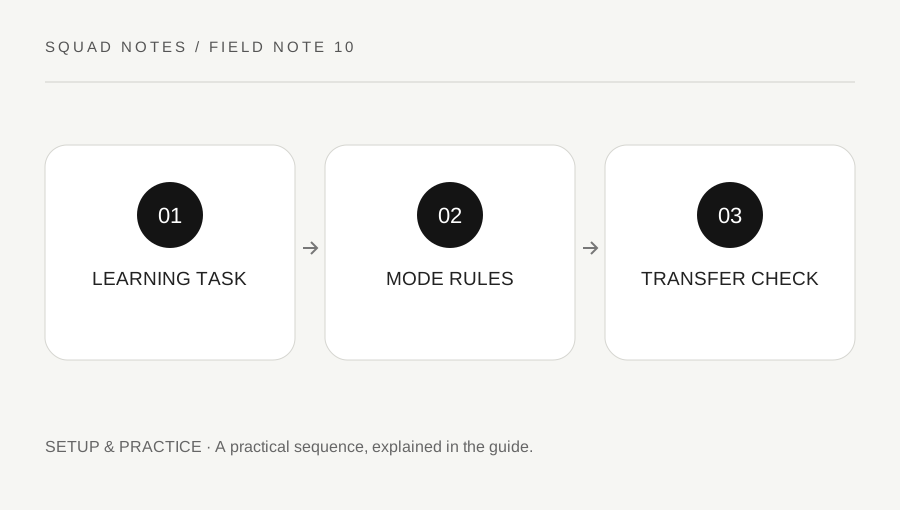
Original explanatory diagram. Examples illustrate a method or decision; they are not claims of personal testing.
Name one learning objective
Choose a task such as recognizing a weapon's behavior, using a Legend's supported ability, maintaining cover during an exchange or coordinating a squad movement. A broad objective like “improve at Apex” does not explain which environment would provide useful repetitions.
EA's current modes guide describes available categories and learning spaces, including Training and the Firing Range. Live playlists can change, so check the game and official page rather than relying on an old mode name from a video. Availability is not guaranteed permanently by this article.
The right choice depends on the task. A controlled practice area can help isolate input or weapon behavior, while a live opponent is necessary to test some decisions. Neither environment automatically replaces the other, and a quick score increase in one mode does not prove equal progress in another.
Match the rules to the repetition you need
Read how the current mode handles lives, equipment, squad structure and objectives. Those rules determine how often you can repeat the target task and what consequences follow a mistake. Do not transfer a respawn or recovery assumption from one mode into another without checking.
For weapon familiarization, a practice space may let you keep the same weapon and distance. For decision-making under incomplete information, a live mode may provide the needed context but also introduces more variables. Make the tradeoff explicit.
For a worked example, a player wants to test an input change. They begin with a stable Firing Range task rather than judging it only through random early loot and different opponents. Later they use an appropriate live mode to see whether the setup remains comfortable when decisions become less controlled.
Use a short session constraint
Set a manageable observation rule, such as identifying the next cover before leaving the current position. Keep it compatible with helping the team and playing the objective. Do not abandon teammates or deliberately disrupt a match merely to collect your own practice repetitions.
Record whether the mode actually exposed the target situation. If the task rarely occurred, change the practice design rather than claiming that more time alone must solve it. A mode with many fights may still be poor for practicing a specific rotation or resource decision.
Avoid interpreting one session's statistics without the rules. Different modes and matchmaking contexts can create different damage, elimination or survival patterns. Those numbers describe their context and should not be treated as interchangeable measures of overall skill.
Check transfer into the intended match context
After practicing, identify one situation in your usual mode where the skill should apply. A cleaner tracking motion may transfer, while a habit based on frequent respawns may require adjustment in a mode with different recovery costs. State the difference before testing it.
Review one encounter rather than judging the entire transfer from a win or loss. Ask whether the practiced action appeared and whether the new context changed its value. If a habit failed, determine whether the mechanical skill was missing or the decision rule no longer fit the mode.
Finish by keeping a three-line record: task, selected environment and next transfer check. Revisit the official mode page when playlists change. A deliberate practice path uses each environment for the repetitions it can provide, while preserving the distinction between learning a controlled action and choosing when that action is useful in a live squad match.
A practical checklist
Choices are saved in this browser. Reset them here or clear this site’s browser storage.
Questions that come up
Does a mode with more fights teach every skill faster?
No. It can increase some repetitions while reducing exposure to other decisions. Match the environment to the learning task.
Are all listed modes always available?
No guarantee is made here. Live playlists change; use the current in-game menu and official guide.
Can I compare statistics directly across modes?
Not without considering their rules, opponents and objectives. Different contexts can produce very different numbers.
References & scope
Background references checked on 18 October 2026. Worked examples and diagrams are original teaching material.