Apex Fight Review: Find the Decision Before the Final Miss
A lost fight is not always an aiming problem. Review the information, position and options available before the final exchange, then choose one decision you can practice in the next session.
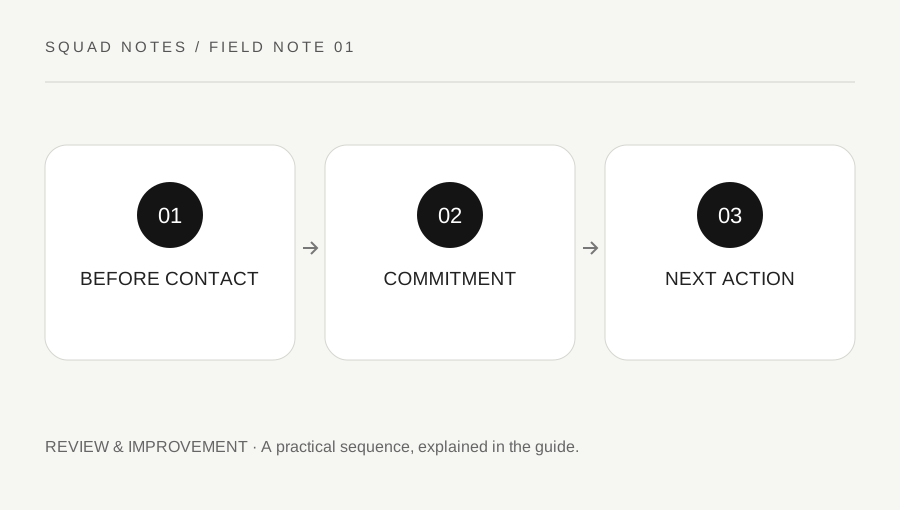
Original explanatory diagram. Examples illustrate a method or decision; they are not claims of personal testing.
Start before the damage exchange
Choose one short encounter rather than reviewing an entire match without a question. Begin at the moment your squad first detected the opposing team. Write what was known: approximate enemy position, your teammates' locations, available cover and the ring situation. Keep information learned later separate from information available at that decision point.
If a recording is unavailable, reconstruct only what you remember confidently. Do not invent a clear enemy position to make the analysis feel complete. A note such as “second opponent location unknown” can explain why the next movement was risky.
This is an original review method, not a claim that every fight has one guaranteed winning choice. Opponents act independently, and outcomes contain uncertainty. The purpose is improving decisions under the information actually available rather than judging every action from the advantage of hindsight.
Find the commitment point
Identify when you gave up an easy retreat, lost a teammate's support angle or spent a movement option that had been preserving safety. That moment can matter more than the last missed shot. Write the action and what it changed, such as “crossed the open gap while the other two players were still behind the previous wall.”
Ask which alternatives were realistically available. Staying behind cover, waiting for the squad, changing angle or declining the fight may have been possible; a theoretical route through an enemy-held building may not have been. Avoid proposing an alternative that required information you did not possess.
Distinguish a reasonable decision with a poor outcome from an unsupported decision that happened to succeed. A review system based only on survival can reward repeated risks until they eventually fail in a more expensive situation.
Separate aim, coordination and position
Use three headings. Under aim, record a specific mechanical issue such as tracking beyond cover. Under coordination, record whether the squad attacked at the same useful time. Under position, record which angles could damage you and which cover remained reachable.
For a worked example, imagine dealing early damage, pushing alone and being eliminated while teammates cannot see the target. More recoil practice may help generally, but the immediate review question is the unsupported commitment. The correction could be confirming a shared push or retaining a return route rather than merely choosing a different weapon.
If network instability or an input problem affected the encounter, note that separately. Do not use every technical possibility as an excuse, but do not diagnose a decision from a clip that clearly froze or lost inputs without acknowledging the limitation.
Turn the review into one testable action
Choose a small next-session rule linked to the observed problem: before crossing toward a damaged opponent, check that at least one teammate has a useful supporting angle. This is an illustrative practice constraint, not a universal tactical law for every match.
After a few relevant encounters, record whether you actually performed the check and what information it supplied. A win is not the only useful result; declining a poor push can show that the decision routine worked. Keep the sample modest and avoid claiming that three matches prove an overall skill increase.
Finish with the original question, the evidence and the next action in three sentences. That compact record is easier to reuse than a long list of everything that went wrong. It also keeps this review distinct from a mechanical aim routine: the target is the decision chain that made the final exchange necessary or avoidable.
A practical checklist
Choices are saved in this browser. Reset them here or clear this site’s browser storage.
Questions that come up
Should every lost fight lead to a sensitivity change?
No. First identify whether aim, positioning, coordination or a technical issue actually caused the problem. A settings change does not repair every decision error.
Can a winning fight still contain a bad decision?
Yes. A risky unsupported action can succeed once. Review the information and options rather than using outcome alone as proof.
Do I need a full-match recording?
No. One short encounter or an honest partial reconstruction can be useful, provided the missing evidence remains visible.
References & scope
Background references checked on 18 October 2026. Worked examples and diagrams are original teaching material.