Apex Third-Party Decisions: Enter a Fight With an Exit
Hearing another fight does not automatically make joining it worthwhile. Compare the information, travel time and return route before turning someone else’s exchange into your squad’s commitment.
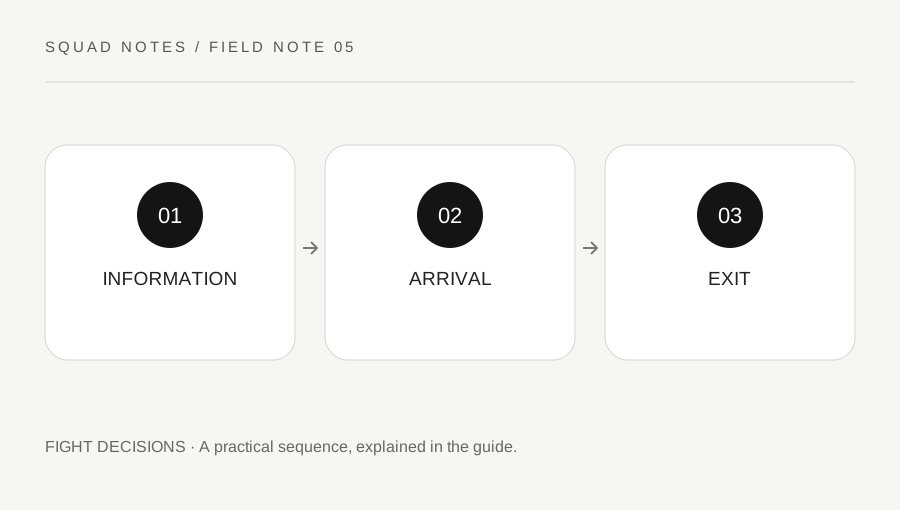
Original explanatory diagram. Examples illustrate a method or decision; they are not claims of personal testing.
Read what the sound does not tell you
Gunfire can indicate activity without revealing every squad, their condition or the exact safe approach. Treat the sound as incomplete information. Check the visible terrain, ring situation and teammates' positions before assuming that two weakened opponents are waiting for a simple finish.
Use clear communication about uncertainty. “Fight ahead, numbers unknown” is more useful than announcing a guaranteed easy elimination. If you cannot identify which building or side of cover contains the action, preserve that gap in the plan.
This article offers an original decision framework rather than a fixed rule about how many seconds a fight must last. Maps, modes, abilities and opponent movement vary. The useful question is whether your squad can arrive in a position from which it can contribute and still respond to new information.
Compare arrival position with the current squad position
Trace the route before moving. A direct path may cross an exposed lane or arrive below several angles. A slightly longer path might preserve cover but miss the moment you hoped to exploit. Neither is automatically correct; identify what each route costs.
Check whether the squad can move together and whether anyone needs to recover or resolve an inventory issue first. One player reaching the fight early does not create a coordinated entry if the others are still far behind. A useful arrival includes supporting angles, not just physical proximity to gunfire.
For a worked example, imagine a fight beyond a ridge with your squad spread across a building. The first decision is regrouping and scouting the approach, not sprinting over the crest because damage sounds frequent. The ridge may conceal another team or leave no immediate cover on the far side.
Define an objective and a stopping condition
Choose what joining is meant to achieve: pressure one exposed angle, secure a useful position or capitalize on a clearly observed opening. “Get involved” is too vague to guide a retreat when the situation changes. Agree on a simple stopping condition such as a new enemy angle or loss of the return route.
Keep the condition practical rather than pretending it predicts every outcome. If another squad appears behind you, update the plan immediately. Continuing the original push because it was announced earlier can turn incomplete information into an avoidable commitment.
Avoid chasing a damaged opponent away from supporting cover unless the new position is understood. Early damage can create an opportunity, but it does not remove the other team's ability to punish a separated player. The objective should remain connected to what your squad can actually support.
Plan the reset before collecting rewards
After an exchange, check cover, squad condition and new threats before concentrating on loot. A third-party entry can itself attract another team. Keep a usable exit or fallback position in mind rather than treating a successful elimination as the end of the tactical problem.
Review the encounter afterward with one question: did the squad enter from an informed position and retain a response when the situation changed? A win alone does not prove the entry was sound, and a loss does not prove every attempt to join another fight is wrong.
Record one concrete improvement, such as regrouping before crossing a ridge or naming a fallback building. That creates a repeatable decision habit. The goal is not to eliminate uncertainty from a multiplayer fight; it is to recognize the uncertainty and avoid committing the squad as though the sound of gunfire supplied all the missing information.
A practical checklist
Choices are saved in this browser. Reset them here or clear this site’s browser storage.
Questions that come up
Is joining a fight always easier than starting one?
No. The other squads’ condition and positions may be unclear, and your approach can expose you to several angles or another team.
Does early damage mean I should chase?
Not automatically. Check the new position, supporting angles and return route before extending the commitment.
Can one timer tell me when to enter?
No universal timer fits every map, mode and encounter. Use current information and squad readiness rather than a fixed promise.
References & scope
Background references checked on 18 October 2026. Worked examples and diagrams are original teaching material.